Broadmoor Asylum
The Surgeon of CrowthorneBroadmoor Asylum, in Crowthorne, Berkshire, was the institution chosen to hold William Chester Minor after his 1872 trial. Conceived as a showpiece of the British penal system, it became the setting for decades of his confinement—but also for the scholarly work and friendships that shaped the story of his life and the Oxford English Dictionary.
Setting and purpose
When the Home Department considered where Minor should be detained, it assigned him to the newly built Asylum for the Criminally Insane at Broadmoor. The institution stood behind high walls and spiked fences in a sprawling collection of red-brick buildings. The book presents it both as an asylum and as part of the penal system: Minor had been found legally innocent of the murder he had committed, yet the sentence required his detention in safe custody, and officials expected that confinement might last for the rest of his life.
The decision transferred him from a temporary prison in Surrey to Broadmoor as soon as arrangements allowed. His status there was formal and enduring: he became Broadmoor Patient Number 742. When the superintendent later explained his circumstances to James Murray, Minor had already been an inmate for more than twenty years and was the institution’s longest-staying resident. Broadmoor was not simply a brief stage between trial and release; it defined the conditions of much of his remaining life.
Confinement and intellectual work
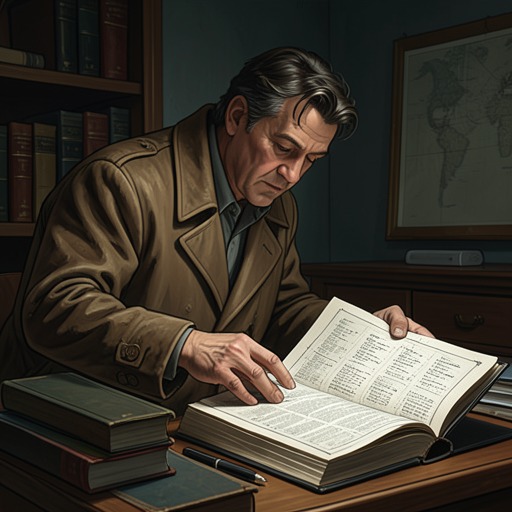
The account gives a more complicated picture of Broadmoor than confinement alone. Minor remained in custody, but he had a room or cell filled with books, and he continued to read, write, and contribute to the Dictionary. His work took place within a restricted life, yet its steady intellectual demands offered him a fixed activity on which to concentrate. The book describes the Dictionary slips as a form of therapy: their routine appears to have brought some release from his paranoia, even though it was not a cure.
The institution’s staff also shaped what Minor could do there. Dr Nicholson, the superintendent, held him in high regard, granted him many privileges, and regularly brought distinguished visitors to see him and his books. Nicholson’s successor showed less special sympathy. That contrast matters: the text suggests that the experience of confinement depended in part on the people administering it, while stopping short of claiming that a more sympathetic regime would have resolved Minor’s illness. It considers the possibility that a more compassionate and enlightened approach might have mitigated his distress, but presents that as conjecture rather than established outcome.
Murray’s visits and a corrected legend
Broadmoor became the meeting place of Minor and James Murray, but the popular account of their introduction was wrong. In a sensational story published by Hayden Church in 1915, Murray supposedly arrived expecting to visit a fellow scholar and discovered instead that his correspondent was a murderer and an inmate. The tale became a durable part of the Dictionary’s history, repeated by later writers despite the absence of a reliable account supporting its dramatic version.
The surviving evidence points to a less theatrical encounter. Murray’s first contact with Minor came around 1880 or 1881, when he knew him only as a capable reader who wrote frequently. At first, Murray assumed that the address at Broadmoor might belong to a medical officer. Their in-person meeting took place in January 1891, after Murray sought permission from Nicholson to visit. The visit began a friendship that lasted almost twenty years; the two men met regularly and shared a deep interest in words. Broadmoor was therefore both the setting of Minor’s confinement and the place where a working correspondence became a personal relationship.
Institutional and narrative significance
The difference between Church’s 1915 scene and the documented January 1891 visit shows how Broadmoor acquired a second life in public memory. The institution’s walls made an arresting backdrop for a story of scholarship joined to criminal insanity, and the sensational version helped turn Minor’s Dictionary work into a popular romance. The later correction does not remove the strangeness of the real history: Murray did visit an inmate whose contributions he valued, and their long association began within the institution. It replaces a single dramatic revelation with a quieter account of correspondence, permission, repeated visits, and friendship.
Broadmoor’s place in the narrative is consequently double. It was the apparatus of long-term custody imposed after the trial, and it was the restricted environment in which Minor sustained a major intellectual collaboration. The book neither treats that work as proof that confinement was therapeutic nor reduces the institution to a backdrop. Its account holds together the loss of freedom, the unevenness of institutional care, and the meaningful but bounded life Minor built around books and Dictionary slips.